Ask any home barista what actually separates "good" espresso gear from "serious" espresso gear, and a lot of them will say the same thing: the ability to pull a shot and steam a pitcher of milk at the exact same moment, without one task stealing heat from the other. A dual-boiler machine does that by running two separate heating circuits instead of splitting one between brewing and steaming. It's the single clearest hardware line between prosumer equipment and everything below it, and these four are where to start once you've decided that line matters to you.
The Four Machines, Ranked
1. Breville Oracle Touch: The Automated One at $2,799.95
The Oracle Touch is unusual for pairing a genuine dual-boiler triple-heat system with a built-in grinder that automatically doses and tamps roughly 22 grams straight into a commercial 58mm portafilter, all driven from a touchscreen. It's the closest thing on this list to prosumer output with super-automatic convenience, undercutting most true manual prosumer machines on price while including hardware, a real grinder, that most of them leave out entirely.
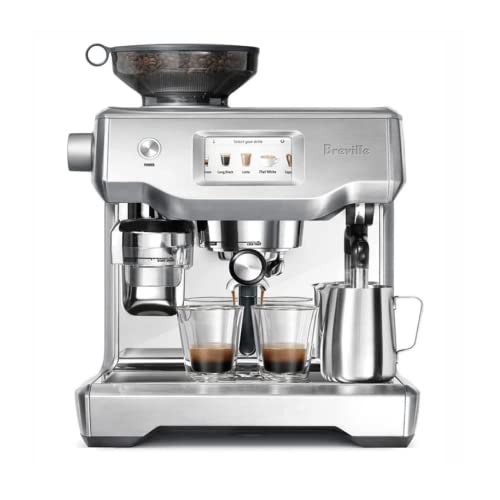
Breville Oracle Touch
Amazon listing: Breville BES990BSS Oracle Touch Espresso Machine, Brushed Stainless Steel
Dual boiler, built-in grinder that auto-doses and tamps ~22g, touchscreen control
2. Rancilio Silvia Pro X: The Value Pick at $1,999
The Silvia Pro X is the least expensive way into a genuine dual-boiler machine without the corner-cutting that usually comes with a lower price tag. In independent testing, its four-hole steam tip has been clocked heating five ounces of fridge-cold milk to 140°F in about 15 seconds, real commercial-grade steam output, not a marketing claim, backed by dual PID control on both the brew and steam circuits. If dual-boiler performance is the specific goal and the budget has a hard ceiling, this is the machine to start with.

Rancilio Silvia Pro X
Amazon listing: Rancilio Silvia Pro X Espresso Machine, 1 liters, Stainless Steel
Dual boiler, dual PID, commercial-grade steam wand
3. ECM Synchronika: The Build-Quality Pick at $3,249
German-engineered and routinely cited as some of the most refined bodywork you can put on a home counter, the Synchronika runs a rotary pump alongside a PID-controlled dual-boiler system inside stainless steel construction that's built to outlast a decade of daily use. It's sold through authorized specialty retailers rather than a marketplace listing, and that's genuinely part of the ownership experience at this price: setup support and long-term parts availability start mattering as much as the spec sheet once a machine costs this much.
ECM Synchronika
German-engineered dual boiler, rotary pump, stainless steel bodywork, $3,249
Not sold on Amazon: this links to Whole Latte Love’s site.
4. Profitec Pro 600: The Flow-Control Pick at $2,399
The Pro 600 runs dual independent PIDs behind an E61 group head, and on the flow-control configuration, adds a paddle that lets you actively shape pressure through the shot instead of accepting a fixed profile, a level of real-time control that otherwise mostly belongs to manual lever machines. It's built for someone who's already comfortable dialing in a shot and wants a bigger lever to pull, not someone looking for their first serious machine.
Profitec Pro 600
Dual PID, E61 group head, optional flow-control paddle add-on, $2,399
Not sold on Amazon: this links to Whole Latte Love’s site.
“Owning two boilers instead of one doesn't make you pull a better shot. It just removes the machine as the reason a good shot goes wrong.”
Rotary or Vibration: The Pump Question Nobody Asks Upfront
The Synchronika and Pro 600 both run rotary pumps instead of the vibration pumps standard on less expensive machines, including the Silvia Pro X and Oracle Touch here. Rotary pumps run noticeably quieter, generate less internal heat, and can pull water directly from a plumbed line rather than a manual reservoir if you're installing the machine permanently. It's a real quality-of-life difference at this price tier, not a spec-sheet flourish, but it's also not a reason on its own to jump two tiers in price if plumbing in a machine isn't something you're planning to do.
What the E61 Group Head Actually Does
Three of the four machines above use an E61 group head, a design Faema introduced in 1961 that's stayed the prosumer standard for over six decades. Its defining trick is thermosiphon circulation: hot water constantly moves through the brass group body whenever the machine is powered on, which keeps the group itself at a stable brew temperature independent of whether the boiler is actively cycling on or off underneath it. That's part of why E61 machines feel so consistent shot after shot even during a busy morning of back-to-back drinks.
Do You Actually Need This Much Machine?
If you're pulling one drink at a time and rarely steaming milk, a well-built single-boiler or thermocoil machine, the Breville Barista Express Impress is a good example, will serve you fine and cost meaningfully less. Dual boilers earn their price specifically when you're making multiple milk drinks in a row, or when shot-to-shot temperature stability has become the thing you actually notice and care about, which is also the exact territory our best machines for latte art guide covers in more depth.
One cost that's easy to underestimate: only the Oracle Touch among these four includes a built-in grinder. Budget an extra $200 to $700 for a standalone one to pair with the other three, depending on which of our best coffee grinders 2026 picks fits your setup, and factor that into the real total before comparing machine prices alone. Browse the full machine collection for every format we cover.