
"Manual brewing" gets used as a catch-all for French press, pour-over and AeroPress, as if the choice between them were mostly cosmetic. It isn't. Each one moves water through coffee by a genuinely different mechanism, full immersion, gravity-driven drip filtration, and pressure-assisted immersion, and each mechanism produces a distinctly different cup. Picking between them isn't about ranking one above the others. It's about matching the mechanism, and the routine that comes with it, to the morning you actually have.
Grind, Time, and Cleanup, Side by Side
| Method | Grind Size | Brew Time | Cleanup | Body |
|---|---|---|---|---|
| French Press | Coarse | 4–5 min | Grounds disposal, mesh rinse | Heavy, textured |
| Pour-Over (V60) | Medium-fine | 2.5–3.5 min | Discard paper filter, rinse | Light, clean |
| AeroPress | Medium-fine | 1.5–3 min | Eject puck, rinse cap | Medium, balanced |
Cleanup deserves more weight in this decision than most buying guides give it. French press means fishing out sodden grounds by hand and rinsing a metal mesh that eventually needs replacing entirely. Pour-over cleanup is nearly instant: lift the paper filter, grounds and all, straight into the trash. AeroPress sits in between. The compressed puck ejects cleanly in one piece, but the rubber seal on the plunger needs occasional attention to keep sealing well over years of use.

AeroPress Original
Amazon listing: AeroPress Original Coffee Press, French Press, Pour-Over & Espresso Style
Fast, portable, pressure-assisted brewing, forgiving of grind inconsistency
Mechanism First: How Each One Actually Works
A French press steeps coarse grounds directly in hot water for several minutes, then a metal mesh plunger separates liquid from solids. Because that mesh lets fine particles and coffee oils pass through in a way a paper filter never would, the resulting cup carries more body and a heavier mouthfeel than either other method. Some drinkers consider that richness the entire point; others find it muddy by comparison. It's also the least technical brewer of the three: no pour pattern, no bloom timing, nothing beyond a timer and a plunge.
A pour-over, the Hario V60 being the clearest example, relies on a paper filter and a controlled manual pour, with gravity doing the actual extraction work. That paper filter strips out fine particles and most natural oils, which is why pour-over produces the cleanest, brightest cup of the three and why it's the default method behind most specialty coffee counters. The tradeoff is real technique: pour rate, pattern and bloom timing all measurably shape the final cup, and getting repeatable results takes practice French press simply doesn't demand.
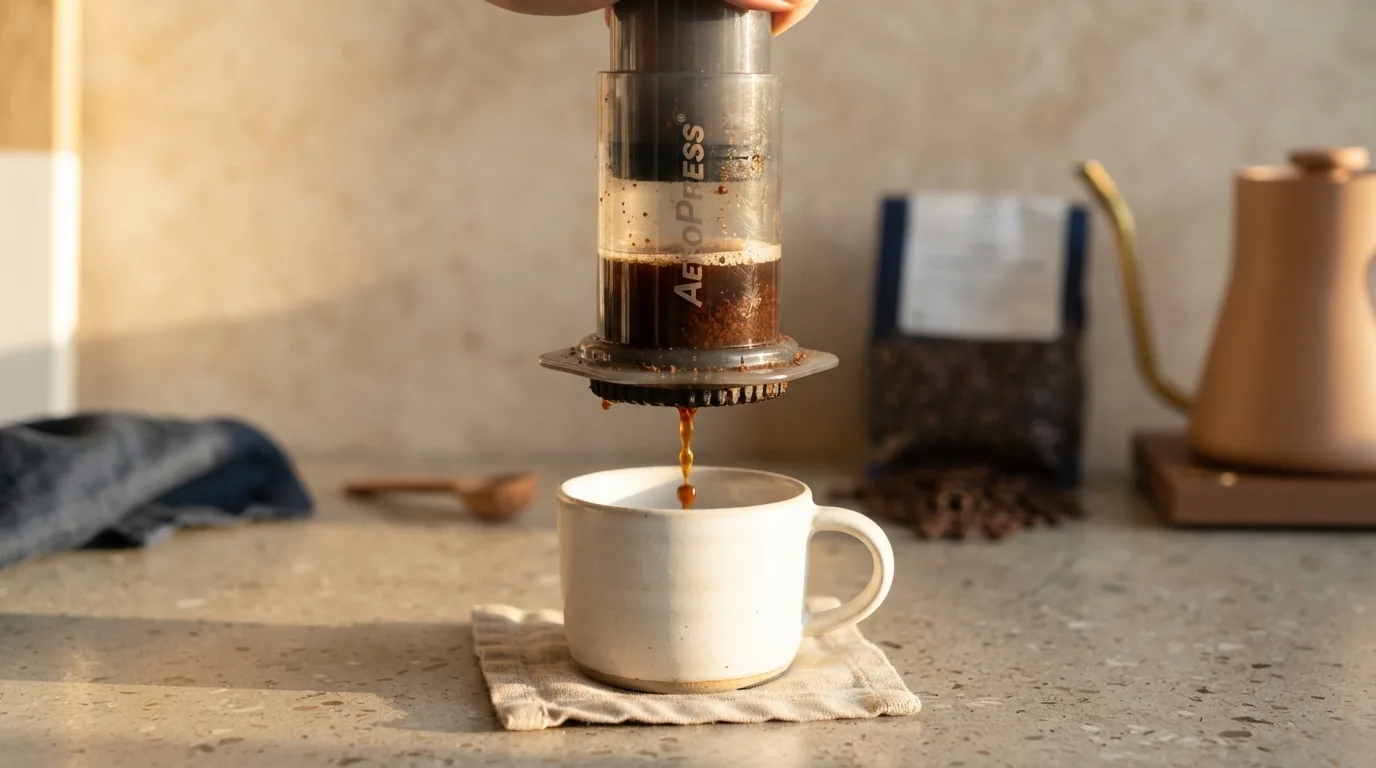
The AeroPress splits the difference mechanically: immersion brewing followed by manual plunging pressure through a paper filter, landing between the other two in both body and clarity. It's fast, frequently under two minutes start to finish, and its small sealed chamber is unusually forgiving of an inconsistent grind, which is a large part of why it's become the default travel and camping brewer.
Bodum Chambord 34oz
The reference French press, borosilicate glass, stainless frame
Ratio Changes More Than Most People Realize
Get the ratio wrong and no amount of grind adjustment fully saves the cup, and these three methods don't share one. French press typically runs a stronger 1:12 (coffee to water by weight) to support its fuller body. Pour-over runs leaner, usually 1:16 to 1:17, to keep the cup clean instead of heavy. AeroPress recipes span the widest range of the three, from concentrated 1:8 to 1:12 "espresso-style" shots meant to be diluted with hot water afterward, to standard 1:15-ish full-cup recipes brewed upright or with the popular inverted technique. If a cup tastes off from any of these methods, checking the ratio before blaming the beans is usually the faster fix.
Hario V60 Ceramic Dripper
The reference pour-over dripper for spiral-groove extraction control
“French press rewards simplicity, pour-over rewards technique, and AeroPress splits the difference. Know which tradeoff you actually want before you buy.”
Matching the Method to the Morning
French press fits a routine where simplicity outranks everything else and a fuller-bodied cup is a feature, not a flaw. Pour-over fits someone who wants the clearest, brightest read on a specific bean and doesn't mind that getting there takes real practice. AeroPress fits anyone who weighs portability and speed as heavily as the flavor itself, or wants one device flexible enough to lean toward either of the other two depending on how it's brewed.
Price almost never decides this one, since all three sit in a similar, modest range. The deciding factor is nearly always the shape of your morning. A rushed weekday favors the AeroPress's sub-two-minute turnaround over any flavor edge the others might have. A slower, more deliberate ritual makes pour-over's demands on technique part of the appeal rather than a cost.
None of these need an outlet, and all three are cheap enough that most serious home setups eventually end up owning more than one. For the grind settings that pair best with each method, see our best coffee grinders 2026 guide, or our moka pot guide if a stovetop brew is the fourth method you're actually curious about.