
Bolt a Bluetooth chip onto a kettle and you've technically made it "smart." Whether you've made it better is a separate question, and for most connected coffee gear released in the last few years, the honest answer is no. The exceptions are worth knowing, though, because a small number of connected tools solve a genuinely specific problem: getting you back to the exact number that produced your best cup, instead of eyeballing it from memory each morning. Three products clear that bar. Here's the test for telling them apart from the rest of the category, and why these three passed it.
The Only Question Worth Asking
Good coffee comes down to repeating a handful of precise variables, water temperature, dose weight, pour speed, closely enough that a great cup stops being an accident. The problem is that human memory is genuinely bad at holding exact numbers day to day. You'll remember "the water felt about right," not "203°F, which is what actually worked with this bean." A connected tool earns its premium when it closes that specific gap: it stores the real number from your best attempt and hands it back to you on command, rather than making you estimate it again from scratch. Judge every "smart" coffee product against that one test before judging anything else about it, including the screen or the app.
The Mug: Solves a Completely Different Problem
This one isn't about brewing a better cup at all, it's about not losing the cup you already made to a cold desk and a long meeting. A connected heated mug holds coffee at a chosen drinking temperature for hours off its charging coaster, and critically, it works perfectly well without the app ever being open. Out of the box it defaults to 135°F, with a 120°F to 145°F adjustable range, and it remembers your last chosen setting automatically the next time you use it.

Ember Temperature Control Smart Mug 2, 14oz
Amazon listing: Ember Temperature Control Smart Mug 2, 14 Oz, App-Controlled Heated Coffee Mug with 80 Min Battery Life and…
Defaults to 135°F, adjustable 120–145°F range, holds temperature for hours, works standalone
The Kettle: Removes Guessing From the Most-Guessed Variable
Water temperature is arguably the single most consequential number in manual brewing, and it's also the one people guess at most confidently while actually being wrong. A connected gooseneck kettle takes the guessing out entirely: dial in an exact target from the kettle's own display or its app, and it heats to that number and holds there rather than drifting as it sits. That matters most for methods sensitive to a few degrees either way, a light-roast pour-over shows temperature swings far more obviously than a forgiving French press grind does.
Fellow Stagg EKG Electric Gooseneck Kettle
Precision variable-temperature control, gooseneck spout, works standalone or via Bluetooth app
The Scale: Shows You the Variable You Can't See With Your Eyes
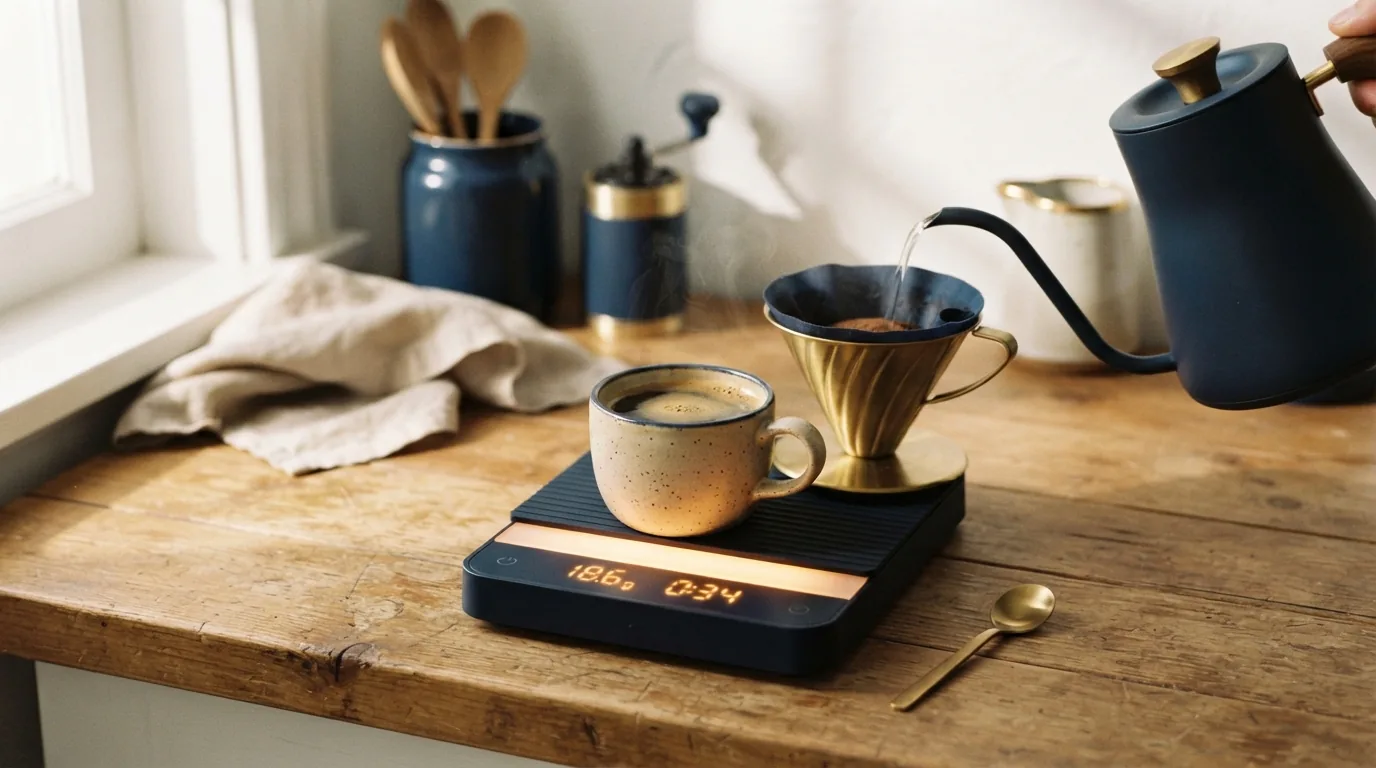
A connected brewing scale does something a plain kitchen scale genuinely can't: it pairs an auto-timer with a real-time flow-rate readout, so you're not just seeing how much coffee you've poured but how fast you poured it. That's a direct, visible read on whether your pour-over technique is actually consistent from one attempt to the next, something "pour steadily" as advice can't give you on its own. Paired with a companion app's built-in brew guides, a fuzzy skill turns into something you can watch and correct mid-pour instead of only diagnosing after the cup is already made.
Acaia Pearl S Coffee Scale
0.1g precision, real-time flow-rate display, Bluetooth app with guided brew timers
“A smart coffee gadget earns its price by removing a variable you were already guessing at. A screen that just looks impressive on a countertop is a different product entirely.”
Where Connectivity Stops Paying Off
WiFi-connected espresso machines are a different case entirely, and mostly not a good one. Remote-start scheduling and push notifications don't change anything about what ends up in the cup. App control on machines like the De'Longhi Eletta Explore, covered in our best super-automatic espresso machines guide, is a real convenience layered on top of hardware that's already good on its own, not the reason that machine makes good coffee in the first place. Evaluate app connectivity on any machine after the brewing hardware, never before it.
None of These Three Actually Require Their App
That's arguably the clearest sign all three passed the test above rather than failing it. The Stagg EKG works as a plain variable-temperature kettle with the app closed. The Pearl S functions as an accurate, fast-responding kitchen scale with the phone in another room. The Ember mug needs no input at all to hold 135°F. In every case, the app is where you go to get specific, not a requirement for the product to do its basic job well. That's the actual line between a smart gadget worth owning and one that's a gimmick wearing a Bluetooth badge.
What These Won't Fix
None of the three substitute for fundamentals. A precise scale doesn't rescue a bad grinder, and an exact-temperature kettle doesn't rescue stale beans; they're refinements for a setup that already has the basics handled. If the fundamentals are still shaky, our milk frother guide and latte art machine guide cover the manual-technique side of the equipment question, and the full accessory collection has the rest of what actually turns a good cup into a precisely repeatable one.
If You're Buying Just One to Start
Start with the scale if your pour-over or espresso technique still varies noticeably day to day; it has the most direct, measurable effect on consistency of the three. Add the kettle next if you're brewing a method genuinely sensitive to exact temperature, light-roast pour-over being the clearest example. The smart mug is the most purely lifestyle-driven purchase of the group, and it's worth buying last, only once cold coffee sitting on your desk has become a real recurring annoyance rather than an occasional one.