

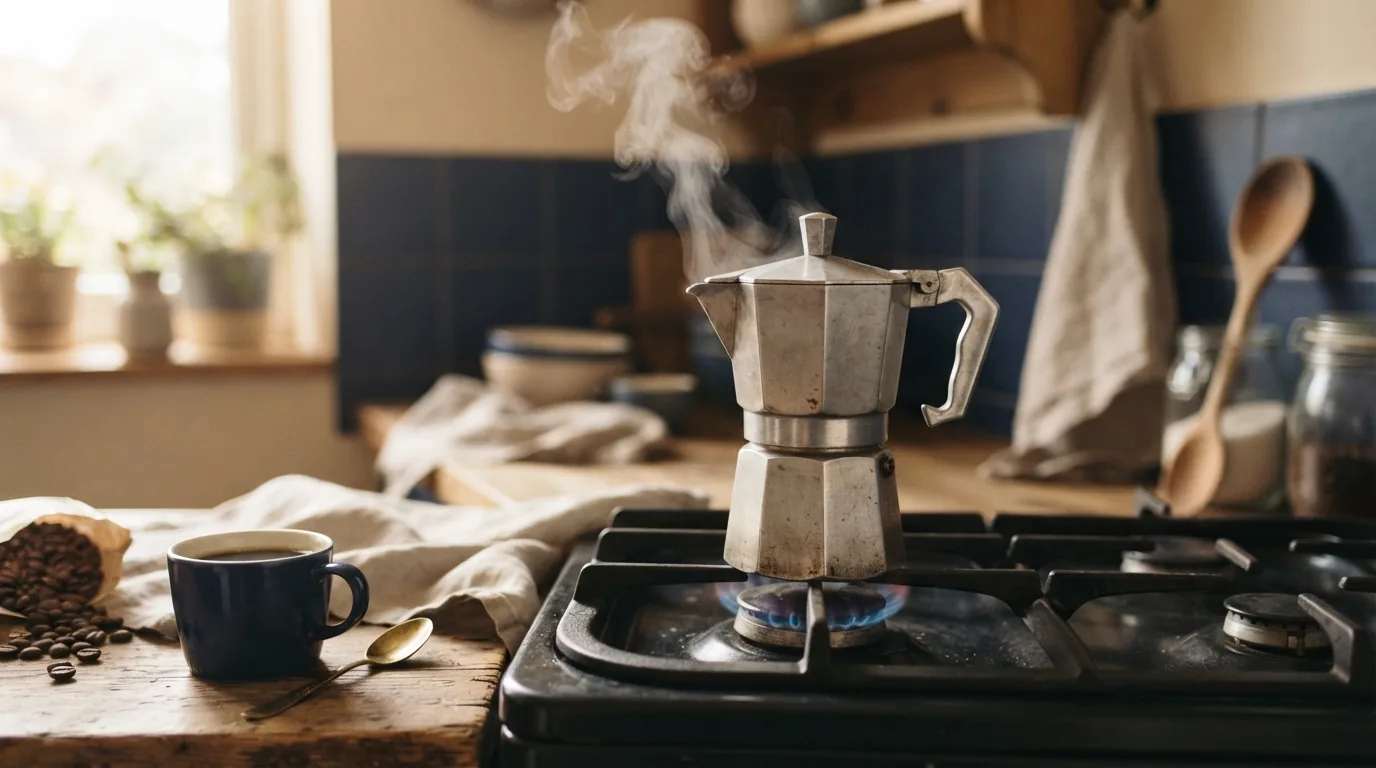
Ask an Italian grandmother what "espresso" tastes like at home and there's a real chance she means moka pot coffee, not the 9-bar café version. The two have gotten conflated for so long that it's worth being precise: a moka pot has been a stovetop fixture since 1933, when the design was patented and brought to market by Alfonso Bialetti, and it makes something genuinely its own, not a homemade espresso, but strong, concentrated coffee with a thin foam cap that borrows some of espresso's visual language without matching its brewing pressure.
Three Chambers, One Simple Idea
The mechanism hasn't needed to change much in nearly a century because it's already efficient. Water sits in a bottom reservoir, ground coffee packs into a middle funnel basket, and a top chamber waits to collect the finished coffee. As the stovetop heats the water, rising steam pressure, generally in the 1 to 1.5 bar range, pushes the hot water up through the grounds and into that top chamber. Compare that to the roughly 9 bar a countertop espresso machine runs at, and the gap explains everything: moka pot coffee is strong and concentrated, but it's a different brewing format entirely, closer to a very intense drip coffee than to true espresso, and worth judging on those terms rather than as an inferior stand-in.
Picking Between the Two Real Options
Bialetti Venus Induction, 10-Cup: Buy This If You Have an Induction Range
Worth starting here rather than at the classic model, because for a lot of buyers this decision gets made by their stovetop before it gets made by preference. The Venus is Bialetti's stainless steel line, engineered specifically to work on induction cooktops, something the aluminum classic physically cannot do since aluminum isn't magnetic. It runs meaningfully more than the classic version, but that premium buys real cooktop compatibility plus the added durability stainless steel has over aluminum.

Bialetti Venus Induction Moka Pot, 10-Cup
Amazon listing: Bialetti Elegance Venus Induction 10 Cup Stainless Steel Espresso Maker
18/10 stainless steel, works on every cooktop type including induction
Bialetti Moka Express, 6-Cup: Buy This for Everything Else
If your stovetop is gas or an electric coil, there's little reason to look past the original. Same octagonal cast-aluminum shape recognized worldwide, same design that hasn't meaningfully changed since 1933, and a genuinely devoted following built on the fact that there's almost nothing here to break, no electronics, no seals beyond a simple rubber gasket that lasts years under normal use.

Bialetti Moka Express, 6-Cup
Amazon listing: Bialetti Moka Express Iconic Italian Stovetop Espresso Maker (Natural Silver, 6 Cups)
Original cast aluminum design dating to 1933, works on gas and electric coil stovetops
“A moka pot was never trying to be a cheap espresso machine. It's a genuinely different format that happens to share a stovetop, a grind range, and a lot of confused marketing with espresso.”
Dialing In the Grind and the Brew
Target a medium-fine grind, texturally similar to table salt, finer than drip coffee but not as fine as a true espresso grind. Fill the funnel basket level with the rim and leave it alone; don't tamp it the way you would an espresso puck, since a moka pot isn't built to force water through packed, resistant grounds, and tamping here just restricts flow unevenly instead of improving extraction. Starting with hot water in the bottom chamber, rather than cold, shortens the time the metal base sits over direct heat before brewing even starts, which some drinkers find reduces a faint metallic note in the finished cup. Brew on low-to-medium heat and pull the pot off the burner the moment you hear the distinctive gurgle that signals the water has fully passed through; letting it run past that point scorches the last of the coffee and pushes the whole batch toward bitter.
Living With Aluminum vs. Stainless Steel
Beyond which cooktop each material works on, the day-to-day differences are real. Aluminum heats fast and costs less but reacts to harsh cleaning, so skip the dish soap and abrasive scrubbing that would strip the pot's built-up seasoning, a hot water rinse and the occasional gentle wash is genuinely all it needs. Stainless steel shrugs off cleaning products, works on any cooktop, and lasts essentially indefinitely, at the cost of heating more slowly and a noticeably higher price for the same capacity.
What "6-Cup" and "10-Cup" Actually Mean
This trips up nearly every first-time buyer: moka pot sizing refers to small demitasse-style cups, not standard mugs. A "6-cup" pot yields roughly two normal mugs' worth of coffee, not six. It's also not a pot you can brew partially; the water-to-coffee ratio is calibrated for a full batch, so a 10-cup pot filled halfway won't give you a proportionally smaller, equally good result, it'll just brew badly. Buy the size that matches what you'll actually drink in one sitting and brew a second batch if you want more, rather than sizing up on the assumption you'll grow into it.
For the deeper mechanics behind why grind size and water temperature shape any brew method's flavor, including a moka pot's, see our science of espresso extraction guide. If you're weighing a moka pot against other manual methods, our French press vs. pour-over vs. AeroPress comparison covers the rest of that landscape, and moka pot coffee is a perfectly reasonable substitute for the espresso shot in our espresso martini guide if you don't own a dedicated machine.
When the Gasket Wears Out, Not the Pot
The rubber gasket sealing the middle and top chambers is the single most common failure point, and it's also the cheapest fix in the entire category. A pot that starts hissing steam from the sides instead of pushing water cleanly through the funnel almost always has a worn gasket, not a structural problem. Replacement gaskets are inexpensive and widely sold for both aluminum and stainless models, and swapping one takes a couple of minutes. There's rarely a good reason to replace an otherwise-working pot over this alone.